GO BACK
House Construction Cost in Kerala (2026): Per Sq Ft Guide
- Published
- NOV 3, 2026
- Category
- Construction
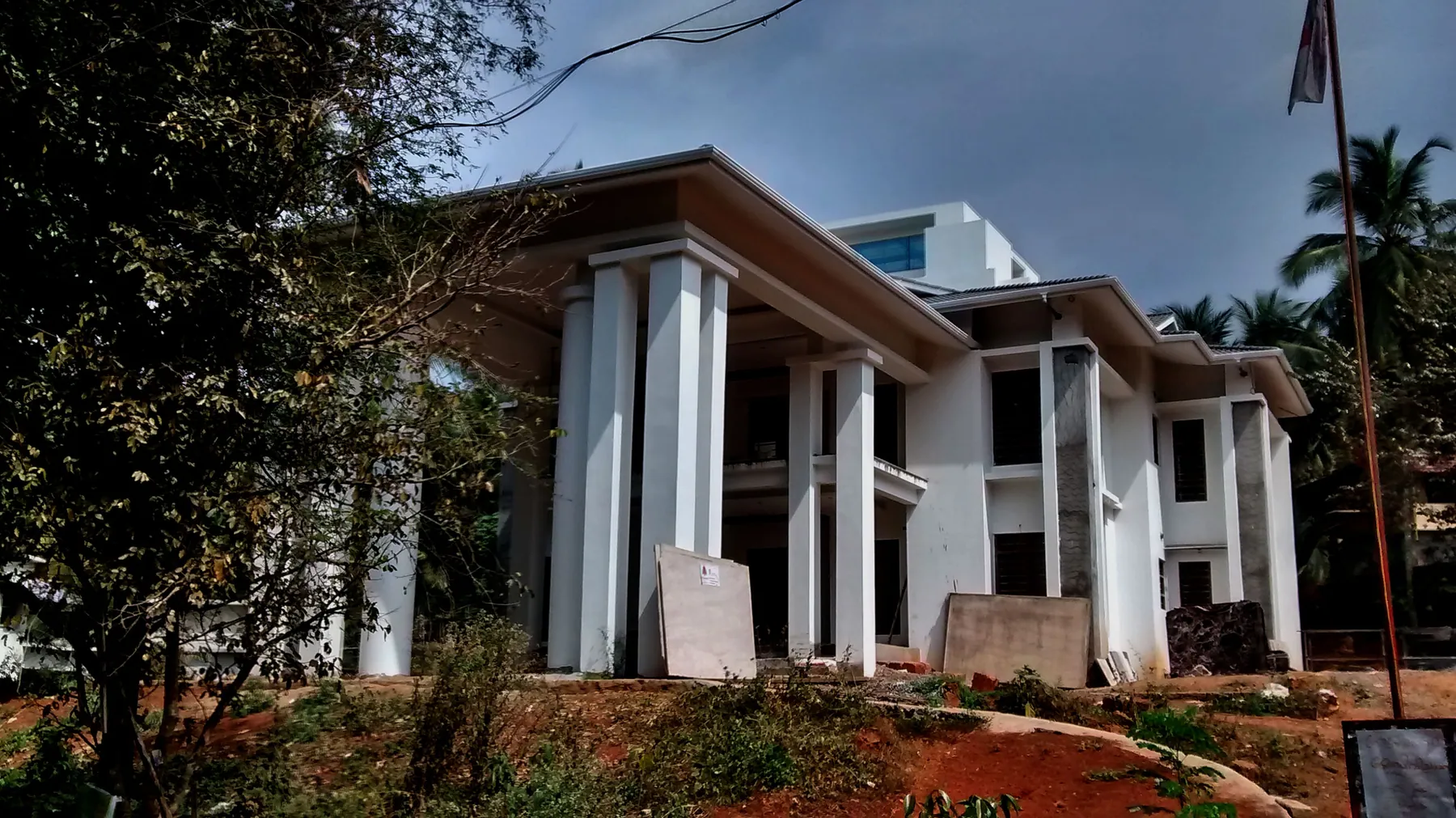
"How much per square foot?" is the first question almost every family asks when they start planning a house in Kerala, and it is the hardest one to answer honestly in a single number. Two homes of 1,800 sq ft in the same panchayat can differ by ₹20 lakh or more, depending on the soil under them, the roof over them and the tiles, taps and windows chosen in between.
This guide gives you the ranges builders in Kerala are actually working with in late 2026, explains what moves a house from one band to the next, and walks through a worked budget for a typical two-storey home. It also lists the costs that rarely appear in the first quotation but always appear in the final bill.
One note before the numbers: every figure here is indicative. Material prices and labour rates change through the year, and a quote for your plot should always come from a site visit and a drawing, not a rate card.
Construction cost per sq ft in Kerala: the 2026 ranges
Most contractors in Kerala quote a rate per square foot of built-up area (the total covered floor area, including walls). Across the state, rates for a complete house with standard finishes currently sit roughly between ₹1,800 and ₹3,000 per sq ft, with premium and custom homes going well above that. Cost guides published in 2026 cluster in the same range, and quotes from Kochi and Thiruvananthapuram tend to sit at the upper end because labour costs more in the cities.
Finish level | Indicative rate (per sq ft) | What it usually means |
|---|---|---|
Basic | ₹1,800 – ₹2,200 | Simple plan, solid concrete blocks, standard vitrified tiles, basic sanitaryware, flat roof or simple truss |
Standard | ₹2,200 – ₹2,800 | The most common choice: good branded fittings, better tiles, some sloped roof work, decent windows |
Premium | ₹2,800 – ₹3,800 | Architect-led design, large glazing, sloped RCC roofs with clay tiles, granite or large-format tiles, branded everything |
Luxury / bespoke | ₹4,000 and above | Imported finishes, home automation, pools, heavy timber work, complex structure |
These rates normally cover the structure and the basic finishes: foundation, frame, walls, roof, plastering, flooring, painting, doors and windows, electrical and plumbing work. They normally exclude land, approvals, interiors (modular kitchen, wardrobes, furniture), the compound wall, landscaping and utility connections. Always ask for the exclusions list in writing.
What actually drives the cost of a house in Kerala
The per sq ft rate is an average. Behind it are a handful of decisions that do most of the work.
The ground under the house
Soil is the first big variable. Much of central Kochi, including low-lying parts of Vyttila, Edappally and the areas close to the backwaters, sits on soft clay or reclaimed land. On such plots a structural engineer will often recommend pile foundations, which can add several lakh before a single block is laid. A firm laterite plot in Kakkanad or on the higher ground towards Aluva may need nothing more than a conventional footing. A soil test (a few thousand to a few tens of thousands of rupees, depending on the number of bore holes) is the cheapest way to avoid a surprise here.
The roof
Kerala houses are defined by their roofs, and the roof is where budgets quietly grow. A flat RCC terrace is the cheapest. A steel truss roof with clay tiles over a flat slab is common and moderately priced. A fully sloped RCC roof finished with Mangalore-pattern or ceramic tiles, with deep eaves on all sides, is beautiful and very good in the monsoon, but it uses more concrete, more steel and more skilled formwork. Our guide to monsoon-proof house design covers why the extra spend is often worth it.
Walling material
The choice between laterite, solid concrete blocks, AAC blocks and burnt bricks changes both the material bill and the labour time. Laterite is still widely used in north Kerala, where it is quarried; in Ernakulam most houses now use solid concrete blocks because they are consistent and easy to source.
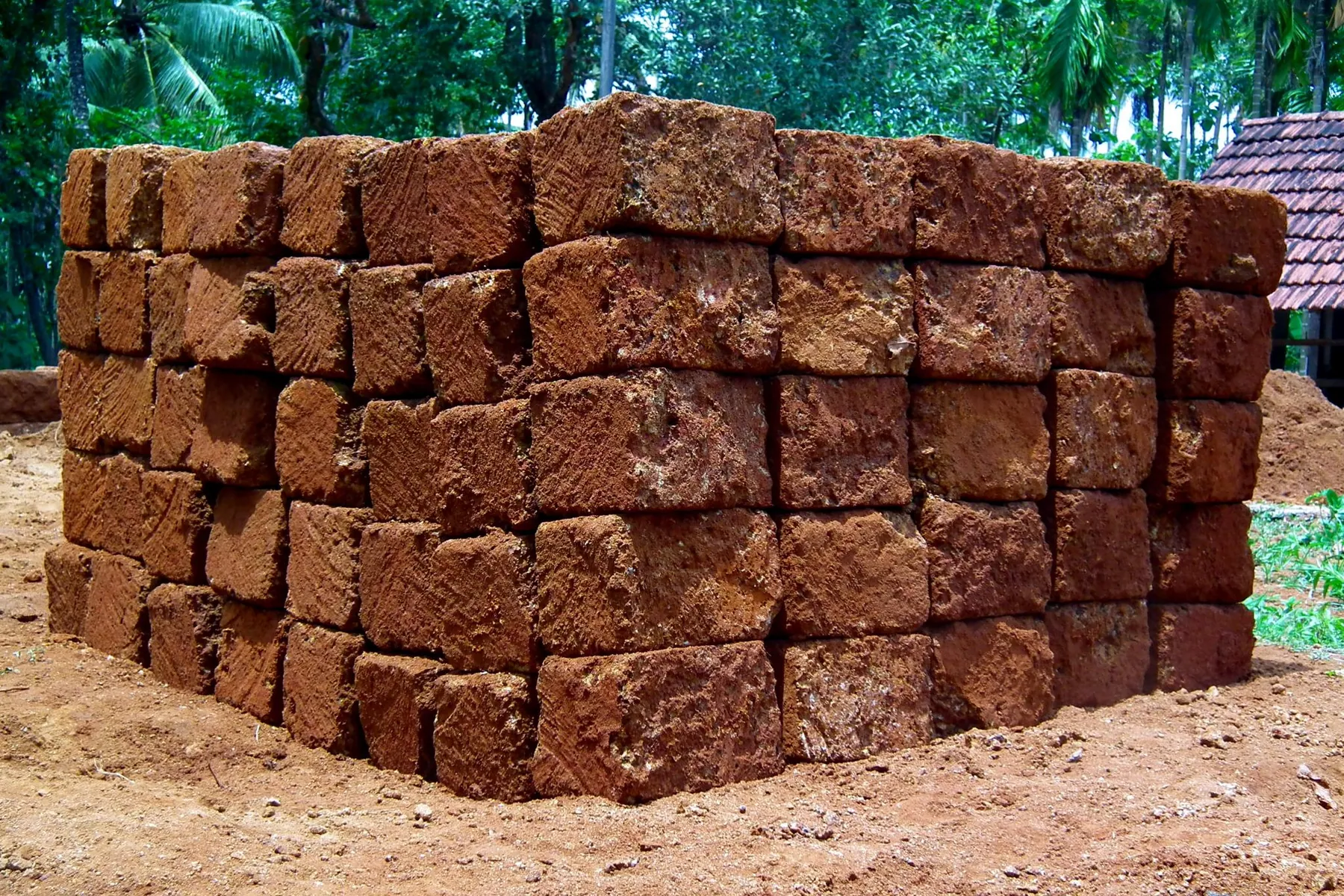
Photo: Ramesh NG, CC BY-SA 2.0, via Wikimedia Commons
Design complexity and spans
Large column-free living rooms, cantilevered balconies, double-height spaces and curved walls all need more steel and more careful formwork. A compact, rectangular two-storey plan is always cheaper per sq ft than a sprawling single-storey one with lots of corners, because you build less foundation and less roof for the same floor area.
Finishes and fittings
This is where families have the most control. The gap between an entry-level and a premium choice for tiles, sanitaryware, CP fittings, switches, doors and windows can easily add ₹300 to ₹600 per sq ft across a whole house. Teak or other solid-timber doors and windows are a classic Kerala upgrade, and a costly one.
Location and logistics
Narrow access roads, plots without space to store material, and sites far from a town all add transport and handling costs. Labour availability also matters. Kerala has some of the highest construction wages in India, and much of the workforce now comes from other states, so timelines and rates move with the seasons and with festivals.
Where the money goes
Cost guides broadly agree on how a typical Kerala house budget splits:
- Civil work (foundation, frame, walls, roof, plastering): roughly 45% to 55%
- Finishing work (flooring, painting, doors, windows, fixtures): roughly 20% to 30%
- Labour: roughly 15% to 20%, sometimes quoted separately
- Electrical and plumbing: roughly 10% to 15%
- Design and approvals: roughly 5% to 10%
In late 2026, published Kerala price lists put cement at roughly ₹390 to ₹470 for a 50 kg bag and TMT steel at roughly ₹63,000 to ₹73,000 per tonne. M-sand has largely replaced river sand in Kerala, and it is noticeably cheaper. These numbers move every few months, so treat them as a snapshot.
A worked example: a 1,800 sq ft home near Kochi
Here is how a realistic budget comes together for a two-storey, three-bedroom house of 1,800 sq ft on a 6 to 8 cent plot on the edge of Kochi, built to a standard finish.
- Core construction: 1,800 sq ft × ₹2,500 = ₹45 lakh
- Interiors (modular kitchen, wardrobes, a few built-ins): ₹6 to ₹12 lakh
- Compound wall and gate (depends on plot perimeter): ₹3 to ₹6 lakh
- Well or borewell, pump and sump: ₹1 to ₹3 lakh
- Design, structural drawings, permit and supervision fees: ₹2 to ₹4 lakh
- Utility connections, landscaping and driveway: ₹1.5 to ₹4 lakh
- Contingency (keep 5% to 10% aside): ₹3 to ₹5 lakh
That takes the realistic all-in figure to somewhere between ₹61 lakh and ₹79 lakh, against a headline of ₹45 lakh. The gap is why so many families feel their project "went over budget" when, in truth, the first number simply did not include half the house.
If you want to run your own numbers, our house cost configurator lets you choose plot size, floors, rooms and finish level and gives you an estimate in a few minutes.
Costs that often get left out of the first quote
When you compare quotations, check each of these line by line:
- Septic tank and soak pit. Some contractors include them, others treat them as extras.
- Sump, overhead tank and plumbing to the well.
- Rainwater harvesting. Under the Kerala building rules as amended in October 2025, rooftop rainwater storage is mandatory for new buildings with a built-up area above 300 sq m, and it is sensible on smaller homes too.
- Electrical fittings. Is the quote for points and wiring only, or does it include lights and fans?
- Grills, handrails and the staircase railing.
- Waterproofing of terraces, bathrooms and sunken slabs.
- Anti-termite treatment before the foundation and the floor slab are cast.
- GST. Ask whether the rate is inclusive or exclusive of GST, and on which parts.
- Building tax. Kerala levies a one-time building tax on new houses through the local body, and houses above 278.7 sq m (about 3,000 sq ft) also attract luxury tax. Your engineer or local body office can tell you the current amount.
How to keep your house within budget
A few habits make the biggest difference.
- Fix the drawings before you sign. Every change after work starts costs more than it would have on paper.
- Ask for an itemised BOQ (bill of quantities), not just a per sq ft rate. A BOQ lets you compare two contractors line for line, and see exactly what grade of tile or brand of pipe is assumed.
- Agree on allowances for finishes. For example, "flooring at ₹80 per sq ft supply cost". If you choose something dearer, you pay only the difference.
- Link payments to stages, such as foundation, each slab, plastering and handover, not to dates.
- Keep a contingency and do not spend it on upgrades in the first month.
- Build compact. A well-planned 1,600 sq ft home often lives better than a poorly planned 2,000 sq ft one.
Frequently asked questions
How much does a 1,500 sq ft house cost in Kerala in 2026?
At a standard finish of about ₹2,200 to ₹2,800 per sq ft, the core construction of a 1,500 sq ft house comes to roughly ₹33 to ₹42 lakh. Once you add interiors, a compound wall, water source, approvals and a contingency, most families should plan for ₹45 to ₹60 lakh in total, excluding land.
Is it cheaper to build a single-storey or a two-storey house?
For the same floor area, a two-storey house is usually cheaper per sq ft because the foundation and roof, two of the most expensive parts, cover a smaller footprint. It also leaves more of your plot open, which matters on the 5 to 10 cent plots common around Kochi.
Does the per sq ft rate include the cost of land?
No. Builders in Kerala quote construction rates on the built-up area of the house only. Land, stamp duty and registration on the land, and the cost of clearing or filling the plot are separate.
Why do quotes for the same house vary so much?
Usually because they are not quoting for the same house. One may assume a different tile grade, leave out the septic tank, or price a flat roof where you wanted a sloped one. An itemised quote based on the same set of drawings is the only fair comparison.
How long does it take to build a house in Kerala?
A typical two-storey home of 1,500 to 2,500 sq ft usually takes around 10 to 14 months from foundation to handover, if drawings and approvals are ready before work starts. The monsoon, material shortages and design changes are the usual reasons for delays.
Planning your own home
A clear budget is the foundation of a calm build. If you are planning a house in Kochi or anywhere in Kerala, start with an estimate in the configurator, look at the homes we have built, and then talk to our team in Kadavanthra. We will visit the plot, look at the soil and access, and give you an itemised quotation you can actually compare.
Cover photo: Kottakkalnet, CC BY-SA 4.0, via Wikimedia Commons
 Related Articles